
Tissue Paper Making Line: Essential Stock Preparation and Energy Efficiency Strategies
The tissue paper industry operates on razor-thin margins where every percentage point of efficiency translates directly to profitability. A well-designed tissue paper making line must balance three competing demands: superior sheet softness and bulk, high machine speeds (often exceeding 2,000 m/min), and the lowest possible energy consumption. This comprehensive guide examines the stock preparation subsystem, approach flow engineering, energy benchmarks, and maintenance protocols that define a world-class tissue production line.
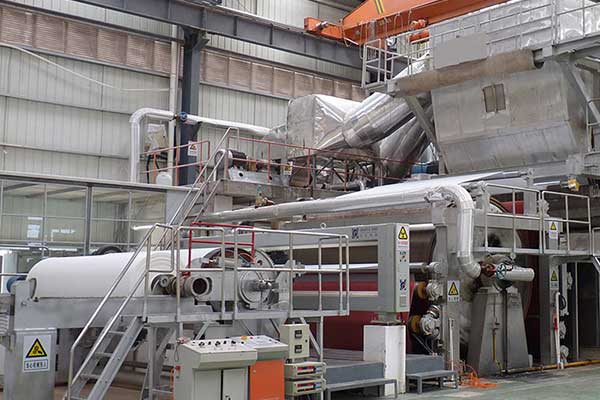
1. Stock Preparation Architecture for Tissue Grades
The stock preparation section of a tissue paper making line is fundamentally different from that of packaging grades. Tissue production demands exceptionally clean, well-refined fiber with precise freeness control. A typical tissue stock preparation system rated at 150-250 TPD (tons per day) comprises several critical stages.
Pulping System: Modern tissue lines employ high-consistency hydrapulpers operating at 12-15% consistency with a batch capacity of 15-30 m³. The rotor typically runs at 180-220 rpm with a motor rating of 200-315 kW depending on production capacity. For virgin pulp processing, pulping time averages 25-35 minutes per batch to achieve complete defibering without excessive fiber cutting.
High-Density Cleaning: Following pulping, the stock passes through high-density cleaners (HD cleaners) operating at 3.0-4.0% consistency with a pressure drop of 1.2-1.8 bar. These centrifugal cleaners remove heavy contaminants such as sand, staples, and metal fragments. A bank of 4-8 HD cleaners in series achieves removal efficiency exceeding 95% for particles above 0.5 mm.
Fine Screening: Pressure screens with basket hole diameters of 1.2-1.8 mm or slot widths of 0.20-0.35 mm are standard in tissue lines. Operating at inlet consistency of 1.8-2.5%, these screens run at a rotor speed of 800-1,200 rpm with a motor power of 55-90 kW. Accept consistency is maintained at 1.5-2.0% while reject rates are controlled at 12-18% of inlet flow.
2. Refining Strategy: Balancing Strength and Softness
Refining in tissue production presents a unique challenge. Unlike packaging grades where maximum strength development is paramount, tissue refining must enhance tensile strength while preserving bulk and softness — properties that normally trade off against each other.
Double Disc Refiner Specifications: For a 200 TPD tissue line, a double disc refiner with 26-34 inch disc diameter is standard. Key parameters include:
- Motor power: 250-400 kW at 1,480 rpm
- Disc plate material: High-chrome cast alloy with Rockwell hardness of 58-62 HRC
- Plate pattern: Fine bar design with bar width of 1.5-2.0 mm and groove width of 2.5-3.5 mm
- Specific edge load (SEL): 0.8-1.2 J/m for tissue grades
- No-load power: 45-60 kW per refiner
- Refining consistency: 3.5-4.5%
Energy Optimization in Refining: Refining typically accounts for 30-40% of total stock preparation energy. At a specific energy input of 60-100 kWh/ton, operators can achieve a freeness reduction of 50-100 mL CSF (Canadian Standard Freeness). The key energy benchmark is net refining energy (total kW minus no-load kW) per ton of production. Best-in-class tissue mills achieve a net refining energy of 40-55 kWh/ton for hardwood furnish and 70-90 kWh/ton for softwood blends.
A critical maintenance consideration: refiner plate life in tissue applications averages 800-1,200 operating hours for softwood and 1,500-2,000 hours for hardwood. Operators should monitor plate wear through amperage changes — a drop of 15% from baseline at the same plate gap indicates plates due for replacement.
3. Approach Flow System: The Final Quality Gate
The approach flow system delivers prepared stock to the headbox at precisely controlled consistency, pressure, and temperature. For a tissue machine running at 1,800-2,200 m/min, approach flow design directly impacts formation quality and machine runnability.
Machine Chest and Basis Weight Control: The machine chest, typically 30-50 m³ capacity, holds stock at 2.8-3.5% consistency. From here, a variable-speed fan pump delivers 12,000-18,000 L/min of diluted stock at 0.10-0.25% headbox consistency. The fan pump motor typically requires 90-160 kW at 1,450 rpm with a VFD for precise speed control.
Pressure Screen (Machine Screen): A final pressure screen positioned immediately before the headbox uses ultra-fine slotted baskets with slot widths of 0.15-0.25 mm. Operating parameters include:
- Inlet pressure: 1.8-2.5 bar
- Pressure drop across basket: 0.3-0.5 bar
- Rotor speed: 900-1,200 rpm
- Motor power: 37-75 kW
- Reject rate: 8-15% of inlet flow
Headbox Supply and Pulsation Damping: Stock leaving the machine screen passes through a pulsation damping system to eliminate pressure fluctuations before entering the headbox. Acceptable pressure variation at the headbox inlet is less than ±0.5% of mean pressure. A properly tuned damping system can contribute to a 2-3% improvement in cross-direction basis weight profile.
4. Energy Consumption Benchmarks and Cost Analysis
Energy represents one of the largest variable costs in tissue manufacturing. Understanding energy consumption across each process stage allows mill managers to identify optimization opportunities with the highest return on investment.
Total Energy Breakdown (per ton of finished tissue):
- Stock preparation (pulping, cleaning, screening, refining): 60-90 kWh/ton
- Approach flow (fan pump, machine screen): 15-25 kWh/ton
- Paper machine drive (wire, press, drying, yankee, reel): 280-350 kWh/ton
- Vacuum system: 80-120 kWh/ton
- Auxiliary systems (compressors, pumps, HVAC): 40-60 kWh/ton
- Total: 475-645 kWh/ton
Optimization Targets: A medium-sized tissue mill producing 50,000 tons annually can reduce energy costs significantly through targeted improvements. Reducing stock preparation energy by 10% (from 75 to 67.5 kWh/ton) saves approximately 375,000 kWh annually — equivalent to $37,500 at an electricity rate of $0.10/kWh. Installing high-efficiency refiner plates alone can reduce refining energy by 8-12% while maintaining equivalent fiber development.
Variable frequency drives on major pumps and refiners typically deliver 15-25% energy savings compared to fixed-speed operation with throttling valves. For a 200 kW refiner motor running 8,000 hours annually, this translates to approximately 240,000-400,000 kWh saved per year.
5. Preventive Maintenance Schedule for Tissue Stock Preparation
A structured maintenance program is essential for maintaining tissue quality and preventing unplanned downtime — which can cost $5,000-15,000 per hour on a high-speed tissue machine.
Daily Checks:
- Monitor refiner motor amperage and compare against baseline curves
- Check pressure screen differential pressure — a rise of 0.2 bar above normal indicates basket blinding
- Inspect all seal water flows at pump glands
- Verify HD cleaner reject rates and inspect reject collection for abnormal debris
Weekly Maintenance:
- Clean pressure screen baskets with high-pressure water (avoid wire brushes on fine-slotted baskets)
- Inspect refiner plate condition through inspection ports — check for uneven wear patterns
- Lubricate all motor bearings per manufacturer specifications
- Calibrate consistency transmitters against laboratory samples
Monthly Service:
- Replace HD cleaner cone tips if visible wear exceeds 2 mm
- Inspect fan pump impeller for cavitation damage
- Check pulsation damping system diaphragms for cracking
- Full vibration analysis on all rotating equipment above 30 kW
Quarterly Overhaul:
- Replace pressure screen basket (typical service life: 2,000-3,000 hours for slotted, 3,000-4,000 hours for drilled)
- Replace refiner plates (service life: 800-2,000 hours depending on furnish)
- Inspect and clean all chest agitators
- Full electrical insulation testing on all motors
Annual Major Shutdown:
- Complete pump overhaul including impeller and wear ring replacement
- Replace all mechanical seals
- Inspect and repair chest linings
- Replace all rubber expansion joints
- Full piping thickness survey at all elbow sections
A structured approach to tissue paper making line design and maintenance delivers measurable results: a 5-8% improvement in machine efficiency, a 10-15% reduction in energy consumption, and a 2-3% enhancement in finished product quality metrics. The investment in proper equipment selection and systematic maintenance yields returns far exceeding the initial capital outlay.
Contact us at leizhanzhang@gmail.com | Zhengzhou Leizhan Technology Paper Machinery Co., Ltd.