
Optimizing a Kraft Liner Paper Making Line for High-Strength Packaging Grades
The Role of Kraft Liner in Modern Packaging
Kraft linerboard is the backbone of the corrugated packaging industry, providing the strength and durability that protects goods during global transport. A well-engineered kraft liner paper making line must produce board with high burst strength, ring crush resistance, and short-span compression (SCT) values while maintaining efficient production rates. Basis weights typically range from 125 to 440 g/m², with the heavier grades requiring careful management of drainage, pressing, and drying capacity.
The defining characteristic of kraft liner production is the raw material. While virgin kraft pulp from softwood provides the highest strength, economic and environmental pressures have driven widespread adoption of old corrugated containers (OCC) as the primary furnish. Modern kraft liner lines routinely run on 80–100% recycled fiber, making stock preparation technology the single most important factor in product quality.
OCC Stock Preparation: The Foundation of Quality
Processing OCC into high-quality linerboard furnish requires a multi-stage system that removes contaminants while preserving fiber length and strength. Leizhan Technology’s stock preparation systems for kraft liner achieve fiber yield rates exceeding 92% from mixed OCC, with contaminant removal efficiency above 98%.
Pulping Stage
The process begins with a high-consistency drum pulper or continuous D-type hydrapulper operating at 12–18% consistency. Leizhan drum pulpers feature a two-zone design: a high-consistency slushing zone (15–18%) for gentle fiberization, followed by a screening zone (3–5%) where contaminants are rejected. Drive power ranges from 200 kW for 300 TPD lines to 750 kW for 1,000+ TPD installations. Pulping time per batch is 20–35 minutes depending on OCC quality.
High-Density Cleaning
After pulping, stock passes through high-density cleaners operating at 3.5–4.5% consistency with a pressure drop of 150–200 kPa. These centrifugal cleaners remove heavy contaminants — stones, metal fragments, glass, and sand — with efficiency above 95% for particles larger than 150 microns. Leizhan HDC series cleaners handle flow rates from 800–4,500 L/min per unit, arranged in banks of 4–24 cleaners depending on line capacity.
Coarse and Fine Screening
The screening system forms the heart of OCC processing. A two-stage screening approach is standard:
- Coarse screens: Vertical pressure screens with 2.0–3.5 mm hole baskets operating at 2.5–3.5% consistency. Reject rate controlled to 15–25% of inlet flow. Leizhan coarse screens feature foil rotors that generate positive-negative pressure pulses for continuous basket cleaning.
- Fine screens: Horizontal or vertical pressure screens with 0.15–0.35 mm slot baskets operating at 1.0–2.0% consistency. These remove stickies, hot melts, and small contaminants. Multi-stage cascading (primary → secondary → tertiary) recovers fiber from the reject stream, with final reject representing less than 2% of total inlet fiber.
Fractionation and Refining
Fractionation screens with 0.10–0.15 mm slots separate long-fiber and short-fiber fractions. The long-fiber fraction (30–50% of total) receives intensive refining in Leizhan DD series double-disc refiners at 3.5–4.5% consistency with specific edge load of 1.5–3.0 W·s/m. The short-fiber fraction receives lighter refining or bypasses refining entirely, preserving drainage while the refined long fibers provide strength. This approach reduces total refining energy by 20–30% compared to full-stream refining.
Paper Machine Configuration and Technical Parameters
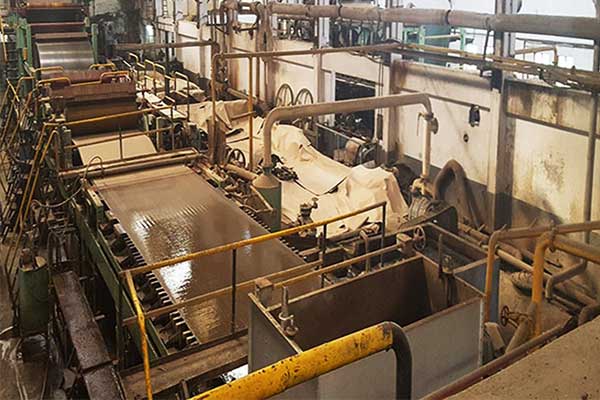
The paper machine section of a kraft liner making line must handle heavy basis weights, high drainage loads, and demanding strength requirements. Key machine parameters include:
| Parameter | Typical Range | Remarks |
|---|---|---|
| Wire width | 3.6–6.8 m | Selected for target production capacity |
| Production speed | 300–900 m/min | Slower than tissue; limited by drying capacity |
| Production capacity | 200–1,200 TPD | Based on 125–440 g/m² basis weight |
| Headbox consistency | 0.4–1.0% | Higher than tissue; varies with basis weight |
| Press section | 2–3 nips, 800–1,200 kN/m | Shoe press for heavy grades |
| Dryer cylinders | 40–80 cylinders | 1.5–1.8 m diameter, multi-tier |
| Steam pressure | 0.3–1.0 MPa | Graduated across dryer groups |
| Size press | Film or pond type | Starch pickup: 2–5 g/m² per side |
Leizhan fourdrinier kraft liner machines feature a long wire section (18–28 meters forming length) with multiple drainage elements: forming board, foil boxes (8–16 blades), wet vacuum boxes, and dry suction boxes arranged for progressive vacuum increase from 2–5 kPa at the early foils to 25–40 kPa at the dry suction boxes.
Energy Consumption Analysis
Kraft liner production is energy-intensive. Understanding and benchmarking energy consumption is critical for cost control:
| Energy Category | Virgin Fiber Line | 100% OCC Line |
|---|---|---|
| Stock preparation (kWh/tonne) | 120–180 | 180–280 |
| Refining (kWh/tonne) | 80–160 | 100–220 |
| Paper machine drives (kWh/tonne) | 80–150 | 80–150 |
| Vacuum system (kWh/tonne) | 60–100 | 70–110 |
| Total electrical (kWh/tonne) | 400–600 | 480–750 |
| Steam consumption (tonne/tonne) | 1.5–2.0 | 1.6–2.2 |
Leizhan’s energy optimization package for kraft liner lines includes VFD-controlled vacuum blowers with automatic load adjustment, closed hood systems with air-to-air heat recovery, and thermocompressor steam systems that reduce fresh steam consumption by 10–18%. The refining system’s fractionation approach alone typically saves 60–100 kWh per tonne of production.
Maintenance Schedule for Sustainable Operation
Kraft liner production runs heavier loads and higher consistencies than tissue, placing different demands on maintenance planning. A structured approach minimizes unplanned downtime:
Daily Maintenance
- Wire tracking and tension monitoring — correct deviations immediately to prevent edge damage
- Refiner plate gap verification — check load consistency across multiple refiners
- Screen basket differential pressure logging — rising dP indicates blinding requiring chemical cleaning
- Press felt moisture profile after uhle boxes — uneven profiles indicate felt wear or clogging
- Dryer condensate removal verification — check siphon operation on each dryer can
Weekly Maintenance
- Press roll doctor blade inspection and replacement if worn beyond 30% of original thickness
- Felt cleaning — batch chemical wash with alkaline detergent followed by acid rinse
- Vacuum pump seal water filter cleaning
- OCC pulper junk trap inspection and waste conveyor function check
Monthly Maintenance
- Screen basket removal and thorough inspection — measure slot/hole dimensions; replace if wear exceeds 10%
- Refiner plate inspection — remove stator and rotor plates; measure bar edge width
- Dryer syphon clearance check (target: 1.0–1.5 mm from shell bottom)
- Gear reducer oil analysis — check for wear metals, water contamination, viscosity change
Semi-Annual Maintenance
- Pressure screen rotor and shaft bearing replacement
- Fan pump wear ring clearance inspection and impeller condition assessment
- Dryer can internal inspection (borescope) for scale buildup
- Complete steam and condensate system audit including all traps, strainers, and control valves
Annual Shutdown (10–16 Days)
- Complete wire replacement (forming fabric life: 60–120 days; replace during annual if close to end of life)
- Press felt replacement (felt life: 45–90 days for pickup felts, 90–180 days for bottom felts)
- Dryer bearing inspection and grease replacement — replace bearings showing any spalling or discoloration
- All refiner complete rebuild — bearing replacement, plate replacement, coupling inspection
- Headbox slice lip grinding and parallelism verification (target: ±0.02 mm across width)
- Dryer shell thickness survey using ultrasonic testing
- Full gearbox inspections with bearing clearance measurements
Quality Parameters and Their Control
Kraft linerboard quality is defined primarily by strength properties verified through standardized testing:
- Burst strength (Mullen): Target 3.5–7.0 kPa·m²/g (burst index). Controlled through refining intensity and long-fiber content.
- Ring crush test (RCT): Target 1.5–3.0 kN/m. Correlates strongly with top-load box compression.
- Short-span compression (SCT): Target 25–40 kN/m for CD direction. Sensitive to fiber orientation and formation quality.
- Concora medium test (CMT): Primarily relevant for fluting but indicative of fiber bonding quality.
- Moisture content: Target 7.0–8.5%. Excessive moisture reduces strength; insufficient moisture causes brittleness.
- STFI (short-span compression) CD/MD ratio: Target above 0.45 for good formation. Ratios below 0.35 indicate excessive fiber alignment.
A kraft liner paper making line from Leizhan Technology delivers the robust construction, energy-efficient design, and precision process control that modern packaging producers require. Each system is configured to the customer’s specific furnish, capacity, and quality targets — ensuring that capital investment translates directly into competitive advantage.
Contact us at leizhanzhang@gmail.com | Zhengzhou Leizhan Technology Paper Machinery Co., Ltd.