
Kraft Liner Paper Making Line: Production Capacity, Refining Strategy & Strength Development
Kraft linerboard is the backbone of the corrugated packaging industry, serving as the outer facings of corrugated boxes that protect goods during transport and storage. The kraft liner paper making line demands robust equipment, precise refining control, and efficient water management to produce board with high burst strength, ring crush resistance, and consistent CD profile. This article provides a technical deep-dive into kraft liner production — from OCC (Old Corrugated Container) processing through to the reel — with practical guidance on optimizing each stage of the line.
Stock Preparation for Kraft Liner: OCC Processing and Contaminant Removal
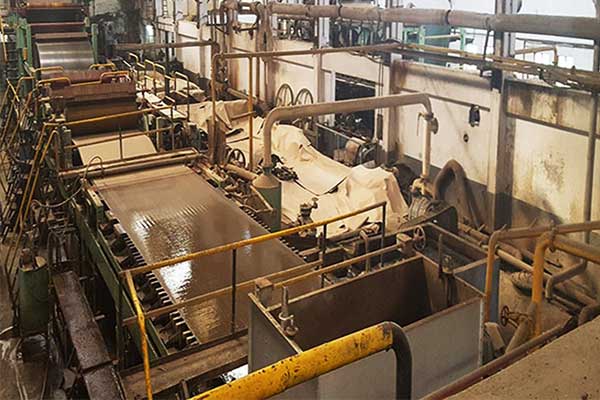
Unlike virgin kraft liner produced from unbleached softwood pulp, much of today’s global linerboard production relies on recycled OCC fiber. A typical OCC-based kraft liner line processes 300–800 TPD of waste paper, demanding high-capacity pulping and efficient contaminant removal.
High-Consistency Pulping
Leizhan’s D-type hydrapulpers for OCC processing operate at 12–15% consistency with rotor diameters from 1,500 to 3,800 mm. At these consistencies, fiber-to-fiber friction provides gentle defibering that preserves fiber length — critical for linerboard strength. Pulping time for OCC is 15–25 minutes per batch with specific energy consumption of 18–25 kWh/t.
Coarse Screening and Cleaning
After pulping, the stock passes through high-density cleaners operating at 3.0–4.5% consistency with a pressure drop of 150–200 kPa. These remove heavy contaminants (staples, stones, glass) with removal efficiency exceeding 98%. The accepted stock then enters a series of pressure screens with 1.2–2.0 mm holes for coarse screening, followed by 0.20–0.35 mm slotted fine screens to remove stickies and small debris.
Fractionation for Multi-Ply Board
For multi-ply linerboard production, fractionation separates the OCC fiber into long-fiber and short-fiber fractions. A pressure screen with 0.15–0.20 mm slots operating at 1.5–2.5% feed consistency achieves separation efficiency of 85–92%. The long-fiber fraction (retained on the screen) goes to the top/bottom ply for strength, while the short-fiber fraction (accepts) fills the middle ply at lower cost.
Refining Strategy for Kraft Liner Grades
Refining is the single most important process variable affecting kraft liner quality. Unlike tissue or fine paper, linerboard refining strategy focuses on strength development rather than formation or smoothness. Key refining parameters include:
| Parameter | Recommended Range | Impact on Board Properties |
|---|---|---|
| Net refining energy | 60–120 kWh/t (virgin) | Increases burst index by 0.5–1.2 kPa·m²/g per 10 kWh/t |
| Specific edge load (SEL) | 1.5–3.5 J/m | Higher SEL favors fiber cutting over fibrillation |
| Freeness drop target | 80–150 mL CSF | Correlates directly with tensile and burst improvement |
| Refiner plate life (OCC) | 400–700 hours | Shorter due to abrasive contaminants in OCC |
| Refining consistency | 3.5–5.0% | Higher consistency improves fibrillation efficiency |
Leizhan’s double-disc refiners with 26–38 inch plate diameters and installed power of 132–500 kW per refiner provide the capacity and control needed for kraft liner production. For a 500 TPD linerboard line, a typical refiner configuration includes 3–4 refiners in parallel, each handling 120–180 TPD of stock with precise load control via PLC-based gap adjustment.
Paper Machine Configuration and Operating Parameters
Kraft linerboard machines range from 2.5 to 6.8 meters trim width with operating speeds from 300 to 1,200 m/min. A typical fourdrinier configuration for single-ply linerboard includes:
- Headbox: Hydraulic headbox with dilution profiling, consistency 0.4–0.8%, slice opening 8–15 mm
- Forming section: Fourdrinier table with 8–14 drainage elements, wire width 3.0–7.0 m, forming board + hydrofoils + vacuum boxes
- Press section: Double-felted nip with 150–250 kN/m loading, achieving 44–48% dryness after press
- Dryer section: 40–70 dryer cylinders in multiple drive groups, steam pressure 2.5–5.0 bar(g)
- Calender/Reel: 2-roll machine calender with 60–100 kN/m nip loading, reeling at 50–130 gsm
The specific steam consumption for the dryer section ranges from 1.3–1.6 tonnes steam per tonne of paper for linerboard. Mills with modern closed hood and heat recovery systems can achieve 1.2–1.3 t steam/t paper, saving approximately $5–8 per tonne in energy costs.
Strength Properties and Quality Control Targets
Linerboard quality is defined by a set of physical properties that determine its performance in corrugated boxes. The following table outlines typical targets for standard kraft liner grades:
| Property | Unit | Grade 125 gsm | Grade 170 gsm | Grade 200 gsm |
|---|---|---|---|---|
| Burst index (min) | kPa·m²/g | 3.0 | 3.2 | 3.4 |
| Ring crush (CD, min) | kN/m | 1.2 | 1.8 | 2.3 |
| STFI (CD, min) | kN/m | 1.5 | 2.2 | 2.8 |
| Cobb 60 (top side) | g/m² | <40 | <40 | <40 |
| Moisture (reel) | % | 7.0–8.5 | 7.0–8.5 | 7.0–8.5 |
| Porosity (Gurley) | seconds | 15–40 | 20–50 | 25–60 |
Achieving consistent strength properties requires regular testing at the reel — burst and ring crush should be measured every 30–45 minutes, with CD moisture profiles scanned continuously by the QCS system. Variations in OCC furnish quality make strength testing frequency even more critical for recycled linerboard mills.
Maintenance Best Practices for Kraft Liner Lines
Kraft linerboard machines operate under harsh conditions: heavy caliper board, abrasive OCC fibers, and high machine speeds create significant wear on critical components. A structured maintenance program must address these conditions:
- Refiner plates: Inspect every 300–500 operating hours with OCC furnish. Plate wear beyond 60% of original bar height requires replacement. Uneven wear patterns indicate misalignment and should be corrected immediately.
- Pressure screen baskets and rotors: Clean and inspect every 4–6 weeks. Slot width increase beyond 0.05 mm over nominal indicates replacement is needed. Rotor foil-to-basket clearance should be checked with feeler gauges and maintained within 0.5–1.0 mm.
- Wire and felt changes: Forming fabric life of 6–12 weeks is typical for linerboard machines. Press felt life ranges from 4–8 weeks depending on nip loading and furnish cleanliness.
- Dryer bearing lubrication: Automatic lubrication systems should deliver grease every 8–12 hours of operation. Manual lubrication, if used, requires daily inspection of all bearing points.
- Steam joint and siphon inspection: Annual inspection during planned shutdowns. Leaking steam joints waste 3–5% of dryer steam consumption — on a 500 TPD machine this translates to over $30,000/year in wasted energy.
Implementing a computerized maintenance management system (CMMS) with work order tracking and spare parts inventory control reduces emergency breakdowns by 25–35% within the first 12 months of full implementation.
Zhengzhou Leizhan Technology supplies complete stock preparation systems for kraft linerboard mills worldwide, including high-consistency hydrapulpers, pressure screens, fractionation systems, and high-capacity double-disc refiners. Our equipment is engineered for the demanding operating conditions of OCC-based liner production, with wear-resistant materials and accessible service designs that minimize maintenance downtime.
Contact us at leizhanzhang@gmail.com | Zhengzhou Leizhan Technology Paper Machinery Co., Ltd.