
Complete Corrugated Paper Making Line: From Wastepaper Bale to Finished Medium and Testliner
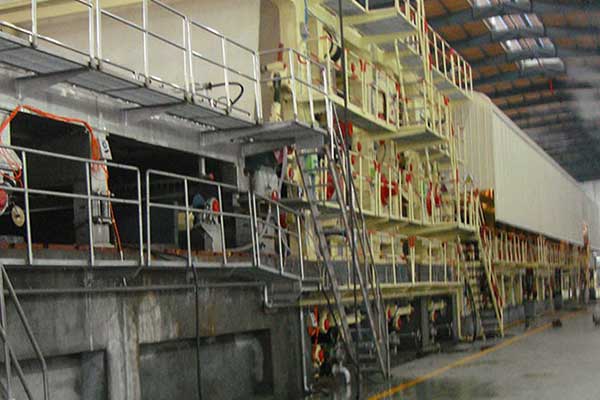
Building or upgrading a corrugated paper making line is one of the most complex engineering decisions a mill owner will make. The equipment chain from the bale conveyor to the reel is long, interconnected, and unforgiving of design shortcuts. A bottleneck at any single stage — pulping, screening, refining, or paper machine approach flow — caps the output of the entire line.
Stage 1: Pulping — Turning Bales into Pumpable Stock
The line starts at the chain conveyor and D-type hydrapulper. OCC bales are fed onto the conveyor continuously and dropped into the pulper vat. Leizhan’s ZD series hydrapulpers handle 150–400 TPD of OCC at 4–6% consistency, with the ragger continuously extracting baling wire and the junk trap capturing heavy tramp. The pulped stock passes through extraction plates with 14–16 mm holes into a dump chest.
Stage 2: High-Density Cleaning and Coarse Screening
After the dump chest, the stock enters high-density cleaners (HDC) that remove heavy contaminants — stones, glass, paper clips, staples — by centrifugal force. Accept consistency target is 3–4%. From there, the stock flows to a coarse pressure screen (hole screen, typically 2.0–2.5 mm) that captures the remaining plastic film, tape, and large stickies that passed the extraction plate.
Stage 3: Fine Screening and Fractionation (Optional)
For testliner production requiring higher strength, the long-fiber fraction after fine screening may be separated from the short-fiber fraction using a fractionation screen with 0.15–0.20 mm slots. The long-fiber accepts go to a dedicated refiner for high-consistency treatment, while the short-fiber fraction is thickened and sent directly to the mixing chest or a separate refiner running at lower intensity. This dual-path approach optimizes both strength (from the long fibers) and formation/smoothness (from the short fibers).
Leizhan’s ZNS series fine screens for corrugated grades are typically configured with 0.20–0.25 mm slot baskets. The multistage cascade (primary, secondary, tertiary) progressively re-screens rejects to maximize fiber acceptance while concentrating the final rejects into a minimal stream.
Stage 5: Thickening — Disc Thickener for the Long-Fiber Fraction
After screening, the long-fiber accepts at 0.8–1.2% consistency must be thickened to 25–30% for refiner feeding. The ZNP series disc thickener handles this with 40–60 discs per unit, achieving outlet consistencies of 8–12% for the pre-thickening stage (before the screw press) or 25–30% after the twin-wire press. Filtrate clarity below 100 ppm TSS ensures minimal fiber goes to the wastewater treatment plant.
Energy Footprint of a Complete Line
A well-engineered corrugated paper making line producing 200 TPD of testliner should consume approximately:
- Pulping: 14–18 kWh/ton
- Screening & cleaning: 8–12 kWh/ton
- Refining: 18–22 kWh/ton
- Thickening: 3–5 kWh/ton
- Auxiliary (pumps, agitators, conveyors): 5–8 kWh/ton
Total: 48–65 kWh/ton of finished stock delivered to the machine chest. Lines exceeding 70 kWh/ton should be investigated for oversized motors, recirculation loops, or equipment running at poor efficiency points on their pump curves.
For mills planning a new corrugated paper making line or upgrading an existing one, our process engineers can provide complete equipment specifications, mass balance, and energy balance calculations for your target production rate and furnish mix.
Need Technical Support for Your Paper Mill?
Contact our engineering team for equipment selection, process optimization, or technical consultation. We provide complete stock preparation and paper making line solutions backed by deep process knowledge.
Email: leizhanzhang@gmail.com