
Corrugated Paper Making Line: High-Capacity Pulping, Screening & Energy-Efficient Production
Corrugated paper — the essential medium and liner materials that compose corrugated board — represents the largest volume segment of the global paper industry. Modern corrugated paper making lines process enormous quantities of recovered fiber, primarily old corrugated containers (OCC), converting what was once packaging waste into high-performance materials for new packaging applications. Production capacities commonly range from 300 to over 1,500 TPD, demanding equipment designed for robust, continuous operation under challenging conditions.
The economics of corrugated paper production favor high-capacity lines that minimize cost per ton through efficient fiber utilization, low energy consumption, and minimal downtime. This article examines the equipment configurations, technical specifications, and operational strategies that define competitive corrugated paper manufacturing.
High-Capacity OCC Pulping Systems
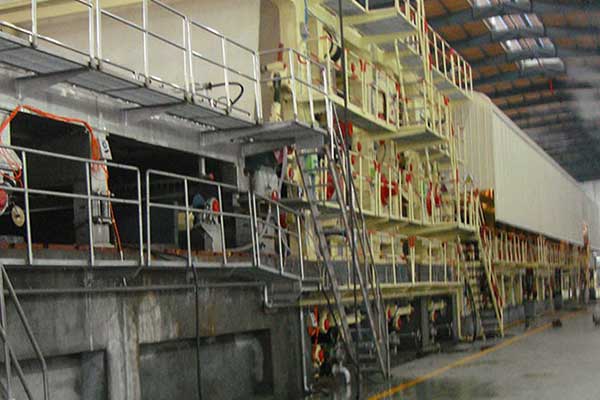
The corrugated paper making line begins with OCC pulping — a critical stage that must balance throughput, fiber quality, and contaminant removal. Modern systems emphasize gentle defibering action that preserves fiber length while achieving complete sheet disintegration.
Drum Pulper Technology for Corrugated Applications:
Continuous drum pulpers rated at 800-2,000 TPD dominate large-scale corrugated mills. The rotating drum (3.5-5.0 m diameter, 20-35 m length) combines pulping and screening functions in a single vessel:
- Pulping Zone: The first 65-75% of drum length operates at 14-18% consistency. Internal baffles lift and drop the OCC-water mixture, generating shear forces that defiber without significant fiber shortening. Residence time of 15-25 minutes ensures complete pulping even for difficult-to-defiber wet-strength grades. Drive power ranges from 400-900 kW depending on drum size and throughput.
- Screening Zone: The remaining drum length features 8-12 mm perforations in the shell. Dilution water showers wash acceptable fiber through these openings while retaining plastic film, wet-strength materials, baling wire, and other large contaminants for discharge at the drum end. The screening zone operates at 3-4% consistency with extraction rates of 85-95% of incoming fiber.
Batch Pulpers for Medium-Capacity Mills:
For lines up to 600 TPD, high-consistency batch pulpers provide an alternative to drum technology. These vessels (12-25 m³ capacity) operate at 12-16% consistency with extraction plates featuring 6-14 mm perforations. Motor power ranges from 250-630 kW, with specific energy consumption of 14-20 kWh per ton. Automatic control sequences manage filling, pulping, extraction, and dump cycles with total cycle times of 10-20 minutes.
Coarse Screening and High-Density Cleaning
Following the pulper, a series of screening and cleaning stages progressively remove contaminants of decreasing size. Each stage must balance removal efficiency against fiber loss and operating cost.
High-Density Cleaners (HD Cleaners):
Positioned immediately after pulper extraction, HD cleaners remove heavy contaminants that would damage downstream equipment. Operating parameters for corrugated applications:
- Inlet consistency: 3.0-4.5%
- Pressure drop: 140-200 kPa
- Centrifugal force: 150-250 G at the cone wall
- Reject rate: 0.3-1.0% of throughput
- Cone diameter: 200-350 mm for high-throughput installations
Contaminants removed include stones (removal efficiency over 98% for particles over 2 mm), metal fragments (over 95%), glass (over 90%), and sand (over 85%). Secondary cleaners recover fiber from primary rejects, typically recovering 60-75% of the fiber content in the reject stream.
Coarse Pressure Screens:
Following HD cleaning, stock at 2.5-3.5% consistency enters coarse screens with 2.0-3.5 mm basket holes. These screens address flat contaminants — plastic film, hot-melt adhesive particles, and defibering-resistant wet-strength materials:
- Screen type: Vertical, upward-flow or outward-flow designs
- Rotor design: Foil or bump rotors generating 30-60 kPa pressure pulses at 5-10 m/s peripheral speed
- Reject rate: 3-8% of feed flow, cascaded through two to three stages
- Motor power: 55-160 kW for typical corrugated line throughputs
- Effective removal: 70-85% of flat plastic, 60-75% of stickies particles over 500 μm
Basket life in OCC applications averages 1,500-3,000 operating hours between cleaning cycles, depending on contaminant load and chemical treatment programs that reduce stickies agglomeration.
Fine Screening, Cleaning, and Thickening
After coarse screening, dilution to 0.8-1.2% consistency prepares stock for the fine screening and cleaning stages that provide final contaminant removal before the paper machine.
Fine Slotted Screens for Corrugated Grades:
Fine screens with 0.20-0.35 mm slots provide the last mechanical contaminant removal stage:
- Slot velocity: 1.0-2.0 m/s through basket openings
- Rotor speed: 8-14 m/s peripheral — higher speeds improve capacity but increase energy consumption
- Reject rate: 12-22% per stage, cascaded through three stages minimum
- Motor power: 90-315 kW for 400-1,000 TPD throughput
Dirt count reduction through fine screening should achieve final values below 50 mm²/m² for standard corrugated medium and below 30 mm²/m² for testliner. Stickies removal efficiency of 85-95% is achievable with properly maintained baskets and optimized process conditions.
Forward Cleaners (Lightweight Cleaning):
Banks of forward cleaners with 75-150 mm cone diameters remove particles with specific gravity less than or close to fiber — wax, polystyrene, and low-density stickies. Three to four stages in cascade configuration concentrate rejects while maximizing fiber recovery:
- Pressure drop: 150-250 kPa per stage
- Reject rate: 8-12% per stage
- Inlet consistency: 0.5-0.8%
- Fiber recovery in cascade: over 98% of incoming fiber to accept stream
Disc Filter Thickening:
Before the paper machine, disc filters thicken stock from 0.8% to 8-12% consistency. Modern disc filters for corrugated applications achieve filtrate clarity below 150 mg/L suspended solids with hydraulic loading rates of 3-6 m³/m²/h. Filter bag or sector replacement cycles average 3-6 months under normal operating conditions.
Refining for Corrugated Paper Strength Development
Refining develops the fiber bonding necessary for the strength properties required in corrugating medium and testliner. For OCC-based furnishes, the refining strategy focuses on fiber development rather than cutting.
Refiner Specifications for Corrugated Applications:
- Disc refiner diameter: 660-910 mm (26-36 inches)
- Motor size: 250-800 kW
- Operating consistency: 3.5-5.0%
- Plate pattern: Coarse-to-medium bar patterns (3-5 mm bar width, 4-6 mm groove width) to preserve fiber length
- Target specific edge load: 2.0-3.5 W·s/m — higher than tissue or fine paper to promote internal fibrillation while minimizing cutting
Energy Targets and Strength Development:
- Corrugating medium (fluting): 60-100 kWh/ton net refining energy — targets CMT (Concora Medium Test) values of 180-260 N depending on basis weight
- Testliner: 80-140 kWh/ton — targets burst index of 2.5-3.5 kPa·m²/g and SCT (Short Span Compression Test) of 20-30 kN/m for 125-200 g/m² grades
Refining energy increases with each recycling cycle as fiber bonding potential diminishes. OCC that has been recycled five or more times typically requires 15-25% more refining energy to achieve equivalent strength compared to fiber with fewer cycles. This reality drives mills to continuously monitor furnish quality and adjust refining targets accordingly.
Paper Machine Configuration and Operating Parameters
Corrugated paper machines prioritize drainage capacity, drying efficiency, and robust mechanical design over the surface properties that dominate fine paper production.
Approach Flow and Headbox:
Fan pumps (200-600 kW for 400-800 TPD machines) deliver stock at 0.5-1.0% headbox consistency through hydraulic headboxes with slice openings of 10-20 mm. Machine screens with 1.0-1.8 mm slots provide final protection against contaminants reaching the paper machine. Dilution control headboxes with 60-100 mm actuator spacing achieve cross-machine basis weight profiles within ±1.5% of target.
Forming Section:
Fourdrinier formers remain standard for corrugated grades, with forming table lengths of 15-30 m depending on machine speed and basis weight range. Key forming elements include forming boards with 1-3° attack angle, foil banks progressing from 3° to 0.5° along the table, wet vacuum boxes at 5-20 kPa, dry vacuum boxes at 25-45 kPa, and couch roll with vacuum zone achieving 18-22% sheet dryness.
Press Section:
Two to three press nips with suction pickup from the wire. Modern configurations employ a shoe press in the third position achieving 48-54% post-press dryness. This significantly reduces dryer steam demand — each percentage point of dryness increase reduces steam consumption by approximately 3-4%.
Dryer Section:
Multi-cylinder dryer sections with 1,500-1,800 mm diameter cylinders operating at steam pressures of 0.15-0.60 MPa. Typical configuration includes 30-55 cylinders in single or double-tier arrangement. Drying rates for corrugated medium range from 20-30 kg H₂O evaporated per m² per hour. Single-felted configurations in the first groups improve runnability at the expense of slightly reduced drying rates.
Energy Consumption and Cost Optimization
Energy represents 15-25% of total production cost for corrugated paper mills. Understanding the energy profile guides improvement investments:
Electrical Energy Range: 450-650 kWh/ton of corrugated paper
- Stock preparation (pulping through thickening): 180-280 kWh/ton
- Paper machine drives: 100-160 kWh/ton
- Vacuum system: 80-140 kWh/ton
- Auxiliaries: 90-140 kWh/ton
Thermal Energy: 1.5-2.0 tons of steam per ton of paper
- Dryer section accounts for 90-95% of steam consumption
- Heat recovery from dryer hood exhaust can recover 35-50% of exhaust energy
- Closed hood systems with dew point control at 55-62°C optimize energy balance between ventilation and heat recovery
Practical Energy Reduction Measures:
- Refiner plate optimization: Properly matched plate patterns to furnish and target freeness can reduce refining energy by 8-15% at equivalent strength development
- Vacuum system optimization: Variable-speed vacuum pumps matching demand to production rate reduce vacuum energy by 15-25%
- Press section upgrades: Shoe press installations reducing steam consumption typically achieve payback periods of 12-24 months based on energy savings alone
- Dryer drainage optimization: Proper siphon clearance (1.5-2.0 mm) and blow-through steam management improve heat transfer coefficients by 10-20%
Conclusion
The corrugated paper making line represents a carefully integrated system where high-capacity pulping, multi-stage contaminant removal, energy-conscious refining, and robust paper machine design combine to produce packaging materials that meet demanding performance specifications at competitive costs. Mills that invest in modern screening technology, refining optimization, and energy recovery systems consistently outperform those operating with legacy equipment in both product quality and production economics.
Contact us at leizhanzhang@gmail.com to discuss your corrugated paper production needs. Our engineering team can help evaluate your current equipment configuration and recommend solutions that improve throughput, quality, and energy efficiency.
Zhengzhou Leizhan Technology Paper Machinery Co., Ltd.