
Corrugated Paper Making Line: Optimized Fluting and Medium Production Technology
Corrugated medium (fluting) and testliner form the core of corrugated packaging, representing the highest-volume paper grades globally. A well-designed corrugated paper making line must process large quantities of recycled fiber at the lowest possible cost while meeting critical quality parameters — particularly Concora Medium Test (CMT) for fluting and Short-Span Compression Test (SCT) for liner grades. This technical guide covers stock preparation, screening configuration, refining strategy, and maintenance practices for cost-effective corrugated paper production.
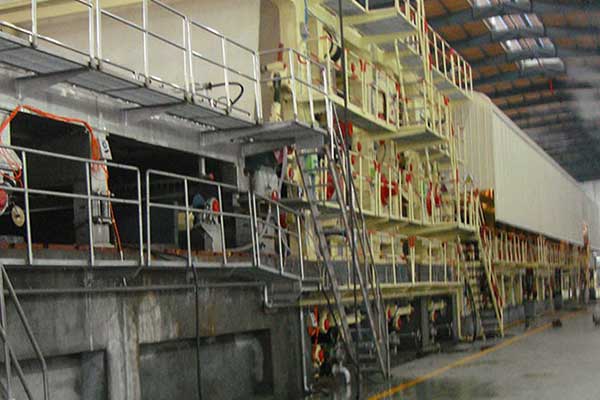
1. High-Volume OCC/Mixed Waste Processing
Corrugated paper mills typically process 300-800 TPD of recycled fiber, primarily OCC (old corrugated containers) with varying proportions of mixed waste paper. The pulping system must handle this high throughput reliably while minimizing contaminant fragmentation.
Drum Pulper for High-Capacity Operations: For production rates above 300 TPD, continuous drum pulpers provide the most efficient defibering:
- Drum diameter: 3.5-4.5 meters, length: 16-25 meters
- Production capacity: 300-800 TPD (baled OCC at 85-92% dry)
- Operating consistency: 15-18% in the high-consistency pulping zone
- Rotation speed: 10-15 rpm (variable speed drive)
- Drive motor: 250-500 kW depending on drum size and capacity
- Specific energy consumption: 18-28 kWh/ton of OCC
- Defibering efficiency: 85-93% single-pass
- Extraction plate hole diameter: 8-14 mm
Ragger and Plastic Removal: Continuous ragger rope systems extract baling wire, plastic straps, and wet-strength materials from the pulper. A well-operated ragger removes 85-95% of wire and plastic while carrying less than 2% fiber loss. Plastic removal trommels downstream separate film and lightweight rejects for disposal.
Secondary Fiber Recovery: Pulper tailings pass through a secondary pulper (50-110 kW, 3-4% consistency, 20-30 min retention) to recover additional fiber before final rejects discharge. This secondary treatment improves overall fiber yield to 94-97% of incoming furnish.
2. Screening and Cleaning System Design
Corrugated grades tolerate higher contaminant levels than cultural or tissue grades, but effective screening is still essential for machine runnability and product quality. The screening system balances contaminant removal efficiency against capital and operating costs.
High-Density Cleaning: An HD cleaner bank processes stock at 3.0-4.5% consistency:
- Individual cleaner capacity: 500-800 L/min
- Inlet pressure: 2.5-3.5 bar with 1.0-1.8 bar pressure drop
- Motor: Not individually powered (pressure-driven cyclonic separation)
- Reject rate: 8-15% (primary stage)
- Two-stage system: Primary accept goes forward; reject feeds secondary cleaner for fiber recovery
- Overall reject discharge: 1-2% of total flow
Coarse Pressure Screening: Hole screens with 2.0-3.5 mm diameter baskets handle stock at 2.5-3.5% consistency:
- Motor power: 90-160 kW per screen for 300-500 TPD lines
- Rotor speed: 550-800 rpm
- Reject rate: 15-25% of inlet flow (single stage)
- Two-stage cascade recovers fiber from primary rejects
- Basket service life: 3,000-4,500 hours in OCC applications
Fine Screening (Slotted): For improved sheet quality, slotted fine screens with 0.25-0.40 mm slot width follow coarse screening:
- Operating consistency: 1.2-2.0%
- Motor power: 75-132 kW
- Rotor speed: 650-900 rpm
- Reject rate: 12-20%
- Basket service life: 2,000-3,500 hours
Lightweight Cleaning (Optional): For mills producing testliner with stricter appearance requirements, forward cleaners (150-250 mm cone diameter) operating at 0.6-1.0% consistency remove polystyrene, hot melts, and other lightweight contaminants. Single-pass efficiency reaches 80-90% for particles with specific gravity below 0.95.
3. Refining Strategy for Corrugated Grades
Fluting and testliner require different refining approaches. Fluting demands stiffness and CMT values while testliner needs SCT and burst strength. A flexible refining system accommodates grade changes and varying fiber quality.
Fluting (Corrugated Medium) Refining: Fluting requires minimal refining to preserve bulk and stiffness:
- Specific energy: 20-40 kWh/ton (significantly lower than liner grades)
- Refining consistency: 3.5-4.5%
- Specific edge load: 0.8-1.2 J/m
- Freeness target: 450-550 mL CSF
- Freeness drop from unrefined: Only 30-60 mL CSF
- Disc refiner: 200-315 kW at 26-34 inch disc diameter for 400 TPD
Testliner Refining: Testliner requires moderate refining to develop SCT and burst:
- Specific energy: 50-90 kWh/ton
- Refining consistency: 3.5-4.5%
- Specific edge load: 1.2-2.0 J/m
- Freeness target: 380-450 mL CSF
- Freeness drop: 80-130 mL CSF
- SCT index improvement: 15-25% over unrefined stock
- Disc refiner: 315-500 kW at 26-34 inch disc diameter for 400 TPD
Fractionation Alternative: Mills with dual-grade capability often install a fractionation screen (0.20-0.30 mm slots) to separate short and long fiber fractions. The long fiber fraction (30-40% of flow) receives high-intensity refining (80-120 kWh/ton) for strength development, while the short fiber bypasses refining to preserve drainage. This approach optimizes fiber utilization and reduces total refining energy by 10-18%.
4. Energy and Cost Benchmarks
Corrugated paper operates on high volume and thin margins — energy cost control is critical to profitability. Understanding energy distribution enables targeted savings.
Stock Preparation Energy Profile (kWh/ton):
- Drum pulping: 18-28 kWh/ton
- HD cleaning and screening: 8-14 kWh/ton
- Fine screening: 6-12 kWh/ton
- Refining (fluting): 20-40 kWh/ton; (testliner): 50-90 kWh/ton
- Pumping and agitation: 8-14 kWh/ton
- Total stock prep: 60-108 kWh/ton (fluting); 90-158 kWh/ton (testliner)
Paper Machine Energy (additional):
- Forming section drives: 25-40 kWh/ton
- Press section: 15-25 kWh/ton
- Dryer section (steam equivalent): 1.3-1.6 tons steam/ton paper (≈260-320 kWh/ton equivalent)
- Vacuum system: 60-90 kWh/ton
- Machine total: 360-475 kWh/ton
Cost Reduction Opportunities:
- Upgrading to high-efficiency drum pulper drives with regenerative braking saves 8-12% pulping energy
- Installing VFDs on all pumps above 30 kW reduces auxiliary energy by 15-20%
- Optimizing screen rotor speed (minimum required for capacity) saves 5-10% screening energy
- Implementing fractionation-based refining for dual-grade mills saves 10-18% refining energy
- Heat recovery from dryer hood exhaust for process water heating saves 8-15% steam demand
For a 500 TPD corrugated paper mill operating 350 days annually, reducing total energy from 450 to 405 kWh/ton (10% savings) translates to 7,875,000 kWh annually — a cost saving of $787,500 at $0.10/kWh.
5. Maintenance Program for High-Capacity Corrugated Mills
High-volume corrugated mills cannot afford extended downtime. A structured preventive maintenance program operating on calendar-based and condition-based triggers maximizes equipment availability.
Daily Monitoring:
- Trend all pressure screen DP values — alarm at 0.2 bar above baseline
- Monitor refiner motor amps — 12% drop triggers plate inspection
- Check ragger rope condition and replacement schedule
- Inspect HD cleaner reject collection — abnormal debris triggers root cause investigation
- Record all pump vibration levels via permanently installed sensors on pumps above 55 kW
Weekly Service:
- Clean coarse screen baskets with high-pressure water
- Clean fine screen baskets — soak in alkaline detergent if stickies buildup is visible
- Inspect drum pulper extraction plates for hole wear (maximum 1.5 mm over original)
- Check refiner plate gap uniformity at 6 positions with feeler gauge
Monthly Maintenance:
- Replace HD cleaner tips showing >2 mm wear
- Inspect fan pump wear rings — >2x original clearance requires replacement
- Calibrate all consistency transmitters and magnetic flow meters
- Ultrasonic thickness check on all pipe bends in abrasive service
- Gearbox oil sampling and analysis for pulper and refiner drives
Quarterly / 2,000-Hour Overhaul:
- Replace coarse screen baskets: 3,000-4,500 hours (hole baskets); 2,000-3,500 hours (slotted)
- Replace refiner plates: 600-900 hours for OCC (abrasive), 900-1,200 hours for cleaner furnish
- Overhaul pump seals on all stock pumps
- Inspect drum pulper drive system — chain tension, sprocket wear, gearbox backlash
Annual Major Shutdown (7-10 days):
- Complete drum pulper overhaul (tire replacement, drive alignment, extraction plate inspection)
- All stock pump overhauls with impeller and wear ring replacement
- Pressure screen rotor bearing and seal replacement
- Full refiner rebuild including disc alignment to within 0.05 mm runout
- Tank cleaning and lining inspection/repair
- Replace all rubber expansion joints
- Complete control valve overhaul and calibration
- Full motor testing (insulation resistance, surge comparison) on all main drives
A corrugated paper making line operating with optimized stock preparation and rigorous maintenance achieves machine availability above 93%, consistent fluting CMT values within ±8% of target, and production costs competitive with the best-performing mills globally. The combination of the right equipment and the right maintenance discipline is the foundation of profitable corrugated paper manufacturing.
Contact us at leizhanzhang@gmail.com | Zhengzhou Leizhan Technology Paper Machinery Co., Ltd.