
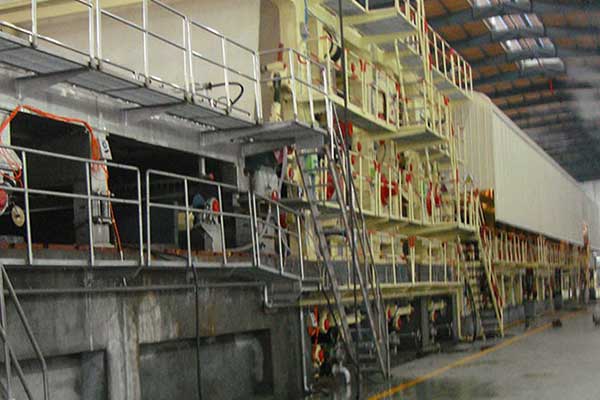
Corrugated Paper Making Line: Efficient Production of Fluting and Testliner Grades
The Growing Demand for Corrugated Packaging Materials
Corrugated packaging is the most widely used transport packaging material globally, and demand continues to grow driven by e-commerce expansion, sustainable packaging trends, and replacement of plastic packaging. A corrugated paper making line produces the two essential components of corrugated board: fluting medium (the wave-shaped inner layer) and testliner (the flat outer layers). These grades are characterized by moderate strength requirements, lightweight basis weights (typically 90–180 g/m²), and heavy reliance on recycled fiber.
The economics of corrugated paper production are driven by three factors: raw material cost (OCC represents 50–65% of total production cost), energy efficiency, and machine productivity. Modern corrugated paper machines must run at high speeds (600–1,200 m/min) with minimal breaks while processing 100% recycled fiber with variable quality.
OCC Processing for Corrugated Grades
Processing OCC for corrugated paper differs from processing for kraft liner in one critical aspect: the tolerance for residual contaminants. While linerboard requires extensive cleaning for surface quality, fluting medium accepts lower-quality fiber because it is hidden inside the corrugated structure. This allows corrugated paper producers to use lower-cost OCC grades while maintaining process efficiency.
Simplified vs. Comprehensive OCC Systems
Leizhan offers two configurations based on raw material quality and end-product requirements:
Standard System (for fluting medium and economy testliner):
- High-consistency pulper (12–16% consistency, 200–500 kW) with junk trap and ragger for continuous contaminant removal during pulping
- High-density cleaner bank (3–4% consistency) for heavy contaminant removal
- Single-stage coarse screening with 2.5–3.5 mm hole baskets at 2.5–3.5% consistency
- Single-stage fine screening with 0.20–0.35 mm slot baskets at 1.2–1.8% consistency
- Optional light cleaning through forward cleaners at 0.6–0.8% consistency
This configuration achieves fiber yield of 88–93% with total system power of 80–140 kWh/tonne.
Premium System (for high-performance testliner):
- Drum pulper or continuous pulper (14–18% consistency, 300–750 kW) with two-zone operation
- High-density cleaner bank with individual reject traps
- Two-stage coarse screening with cascading secondary screen
- Two-stage fine screening with 0.15–0.25 mm slot baskets
- Forward cleaners for lightweight contaminant removal
- Fractionation screening (0.10–0.15 mm slots) with separate long-fiber refining
- Optional dispersion for stickie size reduction
This configuration achieves fiber yield of 90–95% with total system power of 160–260 kWh/tonne, producing higher-strength fiber suitable for demanding testliner applications.
Refining Strategy for Corrugated Grades
Corrugated paper refining focuses on developing compressive strength properties — particularly SCT (short-span compression) and RCT (ring crush) — rather than tensile strength. The refining approach differs by fiber source:
- 100% OCC fluting: Minimal refining, 30–80 kWh/tonne at 3.5–4.5% consistency. The goal is fiber separation and hydration without excessive fines generation that would reduce drainage and increase steam consumption. Specific edge load: 1.0–1.8 W·s/m.
- Testliner: Moderate refining, 60–150 kWh/tonne. Higher energy input develops bonding for surface strength and printability while preserving bulk. Fractionation with selective long-fiber refining improves CD ring crush by 8–15% compared to full-stream refining.
Paper Machine Design for Lightweight Corrugated Grades
Corrugated paper machines are typically fourdrinier or gap-former designs optimized for lightweight grades. Key design features include:
| Parameter | Fluting Medium | Testliner |
|---|---|---|
| Basis weight range (g/m²) | 90–150 | 100–180 |
| Typical production speed (m/min) | 500–1,000 | 400–800 |
| Trim width (m) | 3.2–6.0 | 3.2–6.0 |
| Headbox consistency (%) | 0.3–0.7 | 0.4–0.8 |
| Wire section length (m) | 15–22 | 18–28 |
| Press configuration | 2-nip, 600–900 kN/m | 2–3 nip, 800–1,200 kN/m |
| Dryer cylinders (qty) | 30–55 | 35–65 |
| Post-press dryness (%) | 44–48 | 46–50 |
Leizhan corrugated paper machines feature open-headbox or hydraulic headbox designs with adjustable slice geometry. The wire section includes a forming board, 10–16 foil blades, 4–8 wet vacuum boxes, and 4–6 dry suction boxes. Vacuum levels are carefully graduated to avoid sheet sealing that would trap water and limit drainage capacity.
Energy and Production Cost Analysis
Corrugated paper production is highly cost-sensitive. Energy and fiber represent the dominant variable costs. Benchmark data from well-run corrugated paper lines:
| Cost Component | Consumption | % of Total Cost |
|---|---|---|
| OCC raw material | 1.08–1.15 tonnes/tonne paper | 50–65% |
| Electrical power | 400–600 kWh/tonne | 10–18% |
| Steam | 1.5–2.1 tonnes/tonne paper | 8–15% |
| Chemicals (starch, retention, biocides) | $8–20/tonne | 3–8% |
| Clothing (wires, felts) | $3–8/tonne | 1–3% |
| Maintenance and spares | $8–15/tonne | 3–6% |
| Labor | $10–25/tonne | 5–12% |
Key cost reduction strategies include optimizing OCC yield (each 1% improvement saves approximately $3–5/tonne), reducing refining energy through proper plate selection and fractionation, and maximizing waste heat recovery from the dryer hood exhaust. Leizhan’s energy-efficient designs typically achieve 8–15% lower energy consumption compared to older-generation machines.
Strength Development for Corrugated Grades
Corrugated paper quality is measured by a different set of parameters than printing and writing grades:
- CMT (Concora Medium Test): The defining test for fluting medium. Target values: 140–220 N for 112–150 g/m² grades. CMT measures the flat crush resistance of the fluted medium after conditioning. Developed through fiber bonding and refining control.
- SCT (Short-Span Compression Test): The primary strength parameter for both fluting and testliner. CD SCT targets: 2.0–3.5 kN/m. Correlates directly with box compression strength (BCT). SCT/CD is typically 50–65% of SCT/MD.
- RCT (Ring Crush Test): Target: 1.2–2.5 kN/m for corrugated grades. Correlates with edgewise compression in the finished board.
- CCT (Corrugating Crush Test): Measures the fluted medium’s contribution to board compression after corrugating — actually a better predictor of box performance than CMT for some applications.
- Porosity (Gurley): Target: 15–40 seconds for fluting. Controlled porosity ensures proper starch absorption during corrugating and prevents blowouts during high-speed corrugator operation.
- Moisture: Target: 6.5–8.5%. Critical for corrugator runnability — paper that is too dry causes brittle fractures during fluting; paper that is too wet causes warp in the finished board.
Maintenance Schedule for Corrugated Paper Lines
Corrugated paper machines run high volumes of recycled fiber, leading to specific maintenance challenges: abrasive wear from OCC contaminants, stickie deposition on dryer cans and fabrics, and faster clothing wear from high filler and fines content.
Daily Checklist
- Headbox slice opening verification — measure at 10 positions across the width; parallelism within ±0.1 mm
- Forming wire tracking and tension — misalignment >5 mm from centerline requires immediate correction
- Press section doctor blade condition — replace any blade with edge wear exceeding 25% of original width
- Dryer fabric cleaning shower nozzle check — clean clogged nozzles; uneven cleaning causes moisture streaks
- OCC pulper junk trap — empty at least once per shift; accumulated debris reduces effective pulper volume
Weekly Maintenance
- Pressure screen basket differential pressure trending — clean or replace when dP exceeds baseline by 30%
- Cleaner cone inspection — check for plugging at apex and wear in the cone body
- Forming board blade inspection — replace ceramic blades with chipped or missing segments
- Press felt moisture profile — replace felt if CD moisture variation >4% after uhle box dewatering
- Dryer can surface inspection — note any stickie rings or deposits; schedule chemical cleaning
Monthly Maintenance
- Refiner plate gap measurement — remove stator and rotor; measure bar width; replace when bar edge >2.0 mm
- Screen basket removal and inspection — measure slot/hole dimensions at 12 positions; replace if any >15% oversize
- Fan pump wear ring clearance check — replace rings when clearance exceeds 150% of original
- Gearbox vibration analysis — trending to detect developing bearing or gear failures
- Vacuum pump lobe clearance — adjust to maintain vacuum capacity
Quarterly Maintenance
- Complete wire and felt inspection with thickness profiling
- Dryer syphon clearance verification — ultrasonic measurement from outside shell
- Steam joint and rotary syphon inspection — replace carbon rings showing uneven wear
- All doctor blade holders alignment check — misaligned holders cause uneven blade wear
- OCC pulper extraction plate inspection — hole wear reduces screening efficiency
Annual Shutdown (8–14 Days)
- Complete forming wire replacement
- Press felt replacement (all positions)
- Dryer fabric replacement (all groups)
- Dryer can internal inspection and chemical cleaning — remove scale and stickie deposits
- Headbox complete disassembly, cleaning, and slice lip grinding
- All refiners complete rebuild including bearings and plates
- Pressure screen rotor bearing and mechanical seal replacement
- All gearbox oil change with flush
- OCC pulper vat inspection — check for wear on extraction plates and rotor
- Complete DCS loop tuning and QCS sensor calibration
- Mill alignment survey — all sections from headbox to reel
Corrugated paper production demands rugged, reliable equipment that can handle abrasive recycled fiber while maintaining production efficiency. Leizhan Technology’s corrugated paper making lines are engineered for exactly this challenge — delivering the throughput, reliability, and energy efficiency that make the difference between profit and loss in this cost-sensitive industry.
Contact us at leizhanzhang@gmail.com | Zhengzhou Leizhan Technology Paper Machinery Co., Ltd.